Potatoes
Table potatoes of various varieties and colors. Configuration for washed or unwashed product.
Potato sortingLearn about the applicationIndustrial cameras. AI analysis. Roller transport. ROBOX Vision evaluates color, shape, and product surface, supporting repeatable quality decisions.
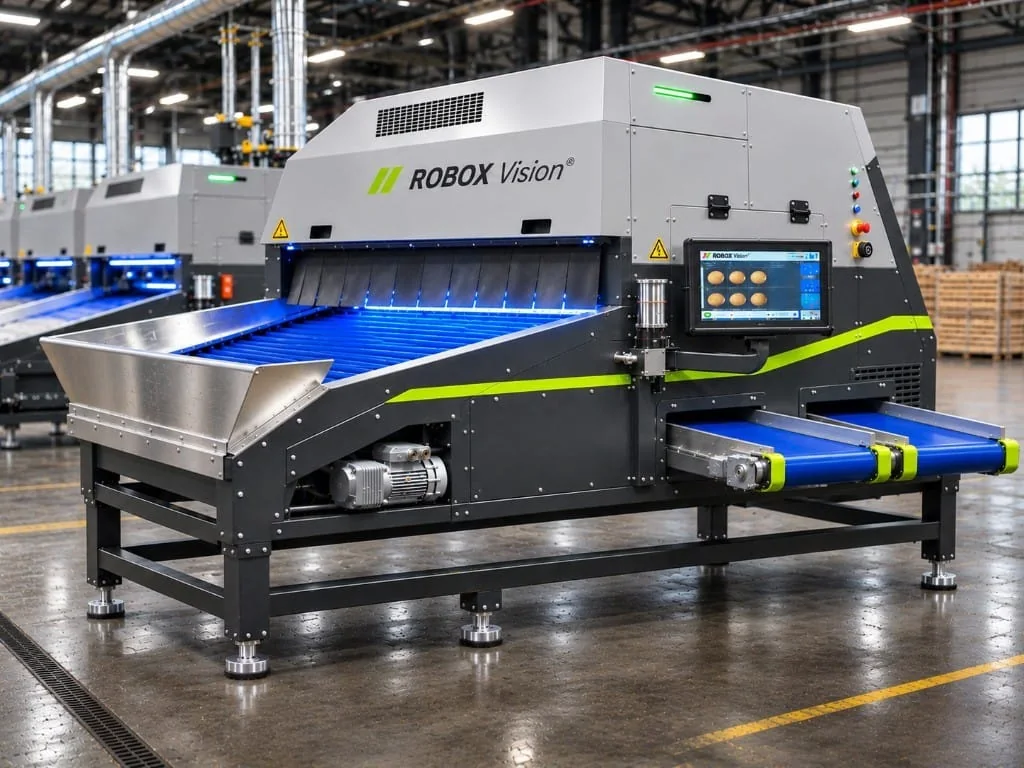
ROBOX Vision — roller optical sorters. We select the model, sorting recipes, and integration for your product and line requirements.
Table potatoes of various varieties and colors. Configuration for washed or unwashed product.
Potato sortingLearn about the applicationYellow and red onion. Configuration tailored to the variety and product preparation.
Onion sortingLearn about the applicationCracks, breaks, and root geometry. Transport and criteria selection for product parameters.
Matching to the productAn interactive library of visual characteristics. All examples are demonstrations; no class represents a validated ROBOX feature.
The frame is a UI animation, not AI segmentation. Visible symptoms are not a disease diagnosis. No fictitious classification confidence is shown.
Integrated path — from product feeding to individual stream collection.
Beam colours are schematic. NIR is neither visible light nor thermal imaging.
ROBOX Vision process animation. Images, analysis, and decisions are simulated. The demonstration illustrates the sorter’s principle of operation.
Photorealistic produce, image capture and selector segments operating after the product leaves the rollers.
Illustrative animation. Playback speed and light pulses demonstrate the process; they do not represent the machine's throughput or operating frequency. The light can be switched off and the demonstration paused.
Controlled product guidance and rotation.
Revealing further fragments of the surface.
Images from multiple perspectives, industrial light.
Assessment of color, shape, and surface.
Defect tolerances matched to the customer's criteria.
Selective diversion of the identified product.
Collection of separated product streams and process monitoring.
Sorting recipes, statistics, and reporting are tailored to the configuration and your facility’s needs.
Roller transport only. Model selection is the starting point for process engineering discussions.
Capacity depends on product, size, feed uniformity, and rejection rate. We adjust the configuration to your line.
Wydajność R650: 4–6 t/h. Wydajność konkretnej partii zależy od kalibru, masy produktu, obsady rolek i udziału odrzutu.
Capacity depends on product, size, feed uniformity, and rejection rate. We adjust the configuration to your line.
Wydajność R1300: 8–12 t/h. Wydajność konkretnej partii zależy od kalibru, masy produktu, obsady rolek i udziału odrzutu.
Capacity depends on product, size, feed uniformity, and rejection rate. We adjust the configuration to your line.
Wydajność R2600: 16–24 t/h. Wydajność konkretnej partii zależy od kalibru, masy produktu, obsady rolek i udziału odrzutu.
Calculate flow for your produce and feeding method. The model accounts for width, spacing, speed, mass and conveyor occupancy.
The result describes the transport of the product under the indicated assumptions. Actual sorting capacity is also limited by image quality, reject rate, product geometry and line integration; it is confirmed by a technological test.
Estimate a simple payback period based on your own costs. Assumptions and results always visible separately.
Open investment analysisProvide the product, quality requirements and flow diagram. Together we will define the scope of the trials.
A sorting line needs coordinated feeding, image inspection and product discharge. A roller sorter presents the surfaces of potatoes or onions to the cameras, and image analysis informs the quality decision. Before choosing the width, establish the actual product flow, available space and conveyor positions. Selection also covers reject handling and connecting the machine to the facility's packing process.
No. The model should suit the product flow, feeding system, available space and downstream machines, rather than maximum width alone.
The ROBOX Vision vegetable sorter combines roller transport with optical evaluation of color, shape, and surface characteristics. Rollers rotate potatoes or onions before cameras, and image analysis supports product separation according to defined quality criteria. If you're looking for a vegetable sorting machine for a farm, packing house, or processing plant, start with the product, required capacity, and feeding method. Optical sorters R650, R1300, and R2600 differ in working width and scale of line integration. Below you'll find application comparisons for potatoes, onions, and carrots; selection criteria are described separately for each product. Systems for frozen vegetables and grains are in the separate ROBOX Select family.
Inspection of color, shape, and surface of edible potatoes. Batch preparation, varietal differences, and examples of defects for selection.
Selection of onions based on visible skin traits, color, and shape. Product preparation and recipe selection for specific varieties.
Inspection of cracks, breaks, discolorations, and deformities. Arrangement of long products and transport matched to facility requirements.
Start by specifying the vegetable type, size range, and quality level you want to achieve. Provide the expected capacity in tons per hour, product condition, rejection ratio, and feeding and receiving method. ROBOX Vision is a family of roller optical sorters for whole vegetables. Compare R650, R1300, and R2600 working widths, and check frozen vegetable requirements in ROBOX Select.
An optical sorter assesses the product using camera images, for example based on visible defects, color, and shape. A mechanical calibrator separates vegetables by size. These devices can work on the same line but perform different functions. When selecting a vegetable sorting machine, specify if you need quality selection, size calibration, or both stages.
Names like vegetable sorter, sorting machine, sorting device, and selector are used at different stages of crop preparation. When inquiring, add “optical” or “camera quality control” if you need automatic evaluation of color, shape, and visible defects. Terms like “vegetable calibrator” and “fraction sorting” mainly refer to size-based separation. We select ROBOX Vision for quality inspection of whole vegetables and integration with other line components.